
People of India
Indira Gandhi
Former Prime Minister; India's first woman PM
Wikipedia — Indira Gandhi ↗Adapted from the linked English Wikipedia article, retrieved 20 November 2026, under CC BY-SA 4.0. Headings and paragraph selections have been edited; source contributors are recorded in the linked article history. Historical statistics retain their original reference periods.
Tags: People · politics
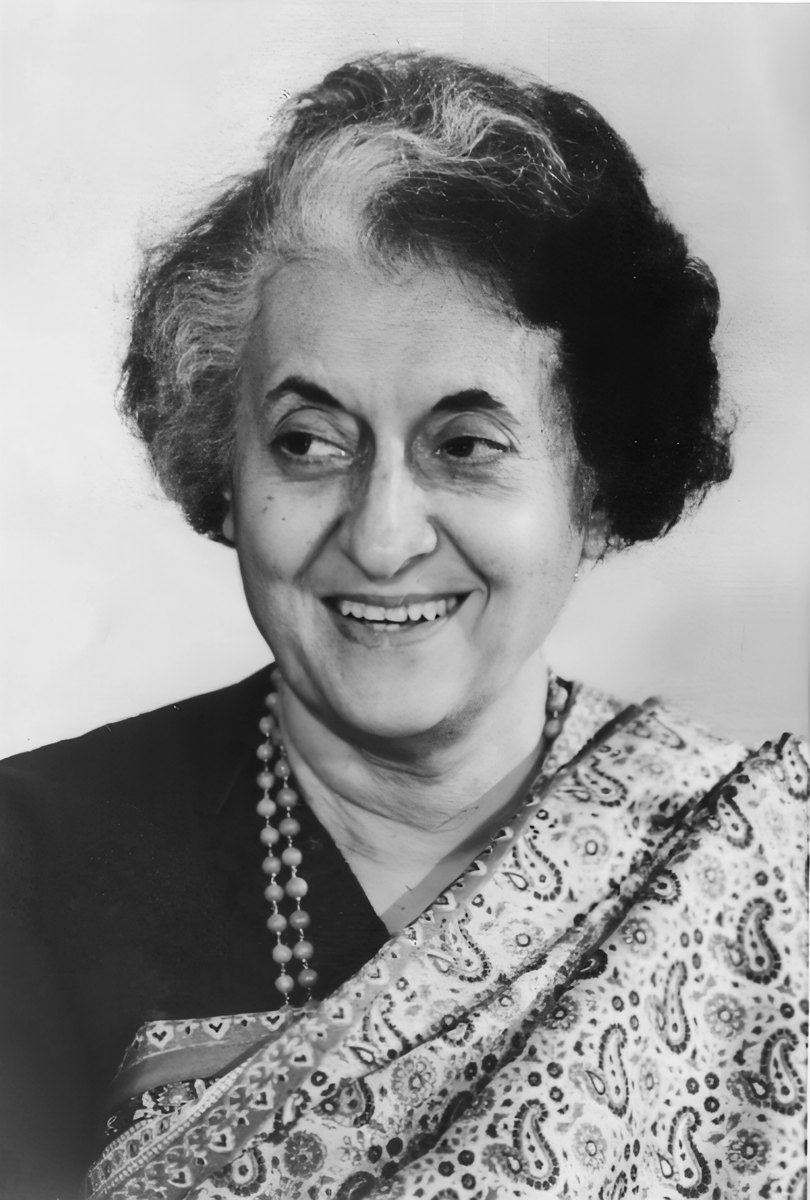
Indira Priyadarshini Gandhi (née Nehru; 19 November 1917 – 31 October 1984) was an Indian stateswoman who twice served as the Prime Minister of India from 1966 to 1977 and again from 1980 until her assassination in 1984. She was India's first and only female prime minister, and a central figure in Indian politics as the leader of the Indian National Congress (INC). Gandhi also served as chairperson of the Non-Aligned Movement (NAM) from 1983 to 1984, becoming the first Indian to hold the position. She was the daughter of Jawaharlal Nehru, the first prime minister of India, and the mother of Rajiv Gandhi, who succeeded her as prime minister. Gandhi was married to Feroze Gandhi, a Member of Parliament, with whom she had two sons, Rajiv Gandhi and Sanjay Gandhi. During her father Jawaharlal Nehru's premiership from 1947 to 1964, Gandhi was his hostess and accompanied him on his numerous foreign trips. In 1959, she played a part in the dissolution of the communist-led Kerala state government as then-president of the Indian National Congress, otherwise a ceremonial position to which she was elected earlier that year. Lal Bahadur Shastri, who had succeeded Nehru as prime minister upon his death in 1964, appointed her minister of information and broadcasting in his government; the same year she was elected to the Rajya Sabha, the upper house of the Indian Parliament, representing Uttar Pradesh. After Shastri's death in January 1966, Gandhi defeated her rival, Morarji Desai, in the INC's parliamentary leadership election to become leader and also succeeded Shastri as prime minister. With her premiership of India she became the world's second female prime minister after Sri Lanka's Sirimavo Bandaranaike. She led the Congress to a majority in the 1967 Indian general election, in which she was first elected to the lower house of the Indian parliament, the Lok Sabha, from Rae Bareli, in Uttar Pradesh. In 1969, the INC expelled Gandhi from the party in a dispute over government policy and party discipline. Gandhi and her supporters formed a new party, the INC (R), which formed India's first coalition government. In the 1971 Indian general election, the INC (R) won a landslide victory, focusing on issues such as poverty. As prime minister, Gandhi was known for her uncompromising political stances and centralisation of power within the executive branch. In 1967, she headed a military conflict with China in which India repelled Chinese incursions into Sikkim, an Indian protectorate in the Himalayas. In the same year, the Naxalbari uprising in West Bengal was suppressed. In 1971, she went to war with Pakistan in support of the independence movement and war of independence in East Pakistan, which resulted in an Indian victory, the end of the Bangladeshi genocide, and the independence of Bangladesh, as well as an increase in India's influence to the point where it became the sole regional power in South Asia. The end of East Pakistan weakened the Insurgency in North-East India. In 1975, Sikkim joined the Indian Union. The same year, Kashmiri separatists had to agree to an accord establishing special autonomous status for Kashmir in return for dropping long-standing demands for a plebiscite. Jammu and Kashmir became a constituent unit of India. Another military operation against Pakistan, codenamed Operation Meghdoot, occurred during her tenure in 1984, which led to India expanding the territory it effectively controlled in the disputed Kashmir region. Gandhi's rule saw India grow closer to the Soviet Union by signing a friendship treaty in 1971 to ward off the perceived geopolitical threat of the alliance between the United States and Pakistan. India received military, financial, and diplomatic support from the Soviet Union during its conflict with Pakistan in the same year. Though India was at the forefront of the Non-Aligned Movement, Gandhi made it one of the Soviet Union's closest allies in Asia, each often supporting the other at the United Nations and in proxy wars in Vietnam, Cambodia, and Afghanistan. Gandhi played a crucial role in initiating India's first successful nuclear weapon test in 1974, codenamed 'Smiling Buddha', a year after the United States and the People's Republic of China established friendly relations, in 1973. Responding to the verdict on State of Uttar Pradesh v. Raj Narain, and citing powers to tackle "internal disturbance" under Article 352 of the Constitution, Gandhi instituted a state of emergency from 1975 to 1977, during which she ruled by decree and basic civil liberties were suspended. More than 100,000 political opponents, journalists and dissenters were imprisoned. Following the Emergency, the INC lost the 1977 Indian general election in the midst of anti-incumbency sentiment in North India — the first such loss for the INC in the history of the Republic of India. She lost her own parliamentary constituency, Rae Bareli, albeit the INC swept the seats in South India and North-East India. She withdrew her membership of INC (R) and was publicly persecuted by the ruling Janata Party government for implementing and directing the Emergency. However, she gained parliamentary immunity by winning the Chikmagalur by-election in Karnataka in 1978. The same year, Gandhi and her supporters formed a new political party, the INC (I). Due to her public perception as a strong leader, public sympathy over her prosecution by the Janata Party government, and the weak governance of the Janata Party ministers, the Congress (I) won the 1980 Indian general election by a landslide and Gandhi returned to the premiership. She represented Medak, then in Andhra Pradesh, from 1980 to 1984. As Prime Minister starting in 1980, Gandhi implemented economic reforms which led to India's fastest GDP growth in its history up till that date, averaging 5.7% for the decade. This was a departure from the so-called Hindu rate of growth in which India grew 3.5% annually from the 1950s to the 1970s. Her second son, Sanjay Gandhi, who was Congress (I) General Secretary, died in an aviation accident in June 1980. Gandhi faced also the Sikh separatist movement throughout her fourth premiership; in response, she ordered Operation Blue Star, which involved military action in the Golden Temple and killed hundreds of Sikhs. On 31 October 1984, she was assassinated by two of her bodyguards, both of whom were Sikh nationalists seeking retribution for the events at the temple. Her death was the trigger for the 1984 Anti-Sikh Riots in the nation's capital, Delhi. Her cumulative tenure of 15 years and 350 days, spanning four terms, makes her the second-longest-serving Indian prime minister after her father and the longest-serving female head of government at the time of her death. Gandhi was cremated at the site now known as Shakti Sthal (transl. 'Place of strength'). The site is marked by a large monolithic rock of iron ore commemorating her as the "Iron Lady of India". Gandhi is remembered as one of the most powerful women in the world. Her supporters cite her leadership during victories over geopolitical rivals China and Pakistan, the Green Revolution, a growing economy in the early 1980s, and her anti-poverty campaign that led her to be known as Mother Indira among the country's poor and rural population. Critics note her cult of personality and authoritarian rule of India during the Emergency. In 1999, she was named "Woman of the Millennium" in an online poll organised by the BBC. In 2020, she was named by Time magazine among the 100 women who defined the past century as counterparts to the magazine's previous choices for Man of the Year.
Early life and career
Indira Gandhi was born in British ruled India as Indira Nehru, into a Kashmiri Pandit family on 19 November 1917 in Allahabad (present-day Prayagraj) in Uttar Pradesh. Her father, Jawaharlal Nehru, was a leading figure in the Indian movement for independence from British rule, and became the first Prime Minister of the Dominion (and later Republic) of India. Indira was her parents' only surviving child (she had a younger brother who died while young); she grew up with her mother, Kamala Nehru, at the Anand Bhavan, a large family estate in Allahabad. In 1930, the Nehru family donated the mansion to the Indian National Congress and renamed it Swaraj Bhavan (meaning abode of freedom). A new mansion was built nearby to serve as the family residence and given the name of the old Anand Bhavan. Indira had a lonely and unhappy childhood. Her father was often away, directing political activities or incarcerated, while her mother was frequently bedridden with illness and later suffered an early death from tuberculosis. Indira had limited contact with her father, mostly through letters.
Indira Nehru was taught mostly at home by tutors and attended school intermittently until matriculation in 1934. She was a student at the Modern School in Delhi, St. Cecilia's and St. Mary's Convent schools in Allahabad, the International School of Geneva in Geneva, the Ecole Nouvelle in Bex in Vaud, Switzerland, and the Pupils' Own School in Poona in Maharashtra and in Bombay, which is affiliated with the University of Mumbai. She and her mother moved to the Belur Math headquarters of the Ramakrishna Mission where Swami Ranganathananda was her guardian. Indira then studied at the Vishwa Bharati in Santiniketan, which became Visva-Bharati University in 1951. During an interview with Rabindranath Tagore, he named Indira Priyadarshini, which means "looking at everything with kindness" in Sanskrit and she became known as Indira Priyadarshini Nehru. A year later, however, she had to leave university to attend to her ailing mother in Lausanne, Switzerland. There it was decided that Indira would continue her education at the University of Oxford. After her mother died, Indira attended the Badminton School in Bristol, England for a short time period and then enrolled at Somerville College in Oxford in 1937 to study history. She had to take the entrance examination twice, having failed at her first attempt with a poor performance in Latin. At Oxford, she excelled in history, political science, and economics but her grades in Latin—a compulsory subject—remained poor. However she was active socially at the university and was a member of the Oxford Majlis Asian Society. During her time in Europe, Indira Nehru was plagued with ill health and was constantly attended to by doctors. She had to make repeated trips to Switzerland to recover, disrupting her studies. She was there in 1940, when Germany rapidly conquered Europe. Nehru tried to return to England through Portugal but was left stranded for nearly two months. She managed to enter England in early 1941, and from there returned to India without completing her studies at Oxford. The university later awarded her an honorary degree. In 2010, Oxford honoured her further by selecting her as one of the ten Oxasians, illustrious Asian graduates from the University of Oxford. During her stay in Britain, Nehru frequently met her future husband Feroze Gandhi (no relation to Mahatma Gandhi). In March 1942 they were married in Allahabad according to Adi Dharm rituals, although Feroze belonged to a Zoroastrian Parsi family of Gujarat. The couple had two sons, Rajiv Gandhi (born 1944) and Sanjay Gandhi (born 1946). In September 1942, Indira Gandhi was arrested over her role in the Quit India Movement. She was released from jail in April 1943. "Mud entered our souls in the drabness of prison," she later recalled her time in the jail. She added, "When I came out, it was such a shock to see colors again I thought I would go out of my mind."
In the 1950s, Indira, now Indira Gandhi after her marriage, unofficially served her father as a personal assistant during his tenure as the first prime minister of India. Near the end of the 1950s, Gandhi served as the president of the Congress. In that capacity, she was instrumental in having the communist-led Kerala state government dismissed in 1959. That government was India's first elected communist government. After her father's death in 1964 she was appointed a member of the Rajya Sabha (upper house) and served in Prime Minister Lal Bahadur Shastri's cabinet as Minister of Information and Broadcasting. In January 1966, after Shastri's death, the Congress legislative party elected her over Morarji Desai as their leader. Congress party veteran K. Kamaraj was instrumental in Gandhi achieving victory. Because she was a woman, other political leaders in India saw Gandhi as weak and hoped to use her as a puppet once elected: Congress President Kamaraj orchestrated Mrs. Gandhi's selection as prime minister because he perceived her to be weak enough that he and the other regional party bosses could control her, and yet strong enough to beat Desai [her political opponent] in a party election because of the high regard for her father... a woman would be an ideal tool for the Syndicate.
Primary years (1966–1984)
Gandhi's first eleven years serving as prime minister saw her evolve from the perception of Congress party leaders as their puppet, to a strong leader with the iron resolve to split the party over her policy positions, or to go to war with Pakistan to assist Bangladesh in the 1971 liberation war. At the end of 1977, she was such a dominating figure in Indian politics that Congress party president D. K. Barooah had coined the phrase "India is Indira and Indira is India."
First Term (1966–1967)
Gandhi formed her government as the Rajya Sabha member from Uttar Pradesh. She was the first indian prime minister from the Rajya Sabha. At the beginning of her first term as prime minister, she was widely criticised by the media and the opposition as the "Goongi goodiya" (Hindi for a "dumb doll") of the Congress party bosses who had orchestrated her election and then tried to constrain her. Indira was a reluctant successor to her famous father, although she had accompanied him on several official foreign visits and played a key role in bringing down the first democratically elected communist government in Kerala. According to certain sources it was the socialist leader Ram Manohar Lohia that first derided her as the "Goongi Goodiya", and it was later echoed by other Congress politicians who were wary of her rise in the party. One of her first major actions was to crush the separatist Mizo National Front uprising in Mizoram in 1966.
Second Term (1967–1971)
The first electoral test for Gandhi was the 1967 general elections for the Lok Sabha and state assemblies. The Congress Party won a reduced majority in the Lok Sabha owing to widespread disenchantment over the rising prices of commodities, unemployment, economic stagnation and a food crisis. Gandhi was elected to the Lok Sabha from the Raebareli constituency. She had a rocky start after agreeing to devalue the rupee, which created hardship for Indian businesses and consumers. The importation of wheat from the United States fell through due to political disputes. For the first time, the party also lost power or lost its majority in a number of states across the country. After the 1967 elections, Gandhi gradually began to move towards socialist policies. In 1969, she fell out with senior Congress party leaders over several issues. Chief among them was her decision to support V. V. Giri, an independent candidate, rather than the official Congress party candidate, Neelam Sanjiva Reddy, for the vacant position of president of India. The other was her announcement that the banks would be nationalised without consulting the finance minister, Morarji Desai. These steps culminated in party president S. Nijalingappa expelling her from the party for indiscipline. Gandhi, in turn, floated her own faction of the Congress party and managed to retain most of the Congress MPs on her side, with only 65 on the side of the Congress (O) faction. The Gandhi faction, called Congress (R), lost its majority in the parliament but remained in power with the support of regional parties such as DMK. The policies of the Congress under Gandhi, before the 1971 elections, also included proposals for the abolition of the Privy Purse to former rulers of the princely states. In 1969, the fourteen largest banks in India were nationalised.
Military conflict with China
In 1967, a military conflict alongside the border of the Himalayan Kingdom of Sikkim, then an Indian protectorate, broke out between India and China. India won by repelling Chinese attacks and forced the subsequent withdrawal of Chinese forces from the region. Throughout the conflict, the Indian losses were 88 killed and 163 wounded while Chinese casualties stood at 340 killed and 450 wounded, according to the Indian Defense Ministry. Chinese sources made no declarations of casualties but alleged India to be the aggressor. In December 1967, Indira Gandhi remarked these developments that "China continues to maintain an attitude of hostility towards us and spares no opportunity to malign us and to carry on anti-Indian propaganda not only against the Indian Government but the whole way of our democratic functioning." In 1975, Gandhi incorporated Sikkim into India, after a referendum in which a majority of Sikkimese voted to join India. The move was condemned as being a "despicable act of the Indian Government" by China. Chinese government mouthpiece China Daily wrote that "the Nehrus, father and daughter, had always acted in this way, and Indira Gandhi had gone further".
Third Term (1971–1977)
Garibi Hatao (Remove Poverty) was the resonant theme for Gandhi's 1971 political bid. The slogan was developed in response to the combined opposition alliance's use of the two-word manifesto—"Indira Hatao" (Remove Indira). The Garibi Hatao slogan and the proposed anti-poverty programs that came with it were designed to give Gandhi independent national support, based on the rural and urban poor. This would allow her to bypass the dominant rural castes both in and of state and local governments as well as the urban commercial class. For their part, the previously voiceless poor would at last gain both political worth and political weight. The programs created through Garibi Hatao, though carried out locally, were funded and developed by the Central Government in New Delhi. The program was supervised and staffed by the Indian National Congress party. "These programs also provided the central political leadership with new and vast patronage resources to be disbursed ... throughout the country." The Congress government faced numerous problems during this term. Some of these were due to high inflation which in turn was caused by wartime expenses, drought in some parts of the country and, more importantly, the 1973 oil crisis. Opposition to her in the 1973–75 period, after the Gandhi wave had receded, was strongest in the states of Bihar and Gujarat. In Bihar, Jayaprakash Narayan, the veteran leader came out of retirement to lead the protest movement there.
War with Pakistan
Gandhi's biggest achievement following the 1971 election came in December 1971 with India's decisive victory over Pakistan in the India–Pakistan war of 1971. That victory occurred in the last two weeks of the Bangladesh Liberation War, which led to the formation of independent Bangladesh. An insurgency in East Pakistan (now Bangladesh) formed in early 1971, with Bengalis and East Pakistanis revolting against authoritarian rule from the central West Pakistan Government. In response, Pakistani security forces launched the infamous Operation Searchlight, in which Pakistan committed genocide among Bengali Hindus, nationalists and intelligentsia. Gandhi's India was initially restrained from intervening in the insurgency but quickly started to support Bengali rebels through the provision of military supplies. Indian forces clashed multiple times with Pakistani forces in the Eastern border. At one point, Indian forces along with Mukti Bahini rebels allied together and attacked Pakistani forces at Dhalai. The attack, supported and later successfully executed by India, was done to stop Pakistani cross-border shelling. The battle occurred more than a month before India's official intervention in December. Gandhi quickly dispatched more troops to the Eastern border with East Pakistan, hoping to support Mukti Bahini rebels and cease any Pakistani infiltration. Indian forces then clashed again with Pakistani forces after Indian forces crossed the border and secured Garibpur after a one-day battle lasting from 20 November 1971 to the 21st. The next day, on 22 November, Indian and Pakistani aircraft engaged in a dogfight over the Boyra Salient, in which thousands of people watched as four Indian Folland Gnats shot down two Pakistani Canadair Sabres and damaged another. Both Pakistani pilots that were shot down were captured as prisoners of war. The Battle of Boyra instantly made the four Indian pilots celebrities and created large-scale nationalism as the Bangladesh Liberation War saw more and more Indian intervention and escalation. Other clashes also happened on the same day but did not receive as much media attention as did the battle of Boyra and Garibpur. On 3 December 1971, the Pakistan Air Force launched Operation Chengiz Khan, which saw Pakistani aircraft attacking Indian airbases and military installations across the Western border in a pre-emptive strike. The initial night-time attack by Pakistani forces was foiled, failing to inflict any major damage on Indian airbases, allowing Indian aircraft to counterattack into West Pakistan. Gandhi quickly declared a state of emergency and addressed the nation on radio shortly after midnight, stating: "We must be prepared for a long period of hardship and sacrifice." Both countries mobilised for war and Gandhi ordered full-out war, ordering an invasion into East Pakistan. Pakistan's navy had not improved since the 1965 war, while the Pakistani airforce could not launch attacks on the same scale as the Indian airforce. The Pakistan Army quickly attempted major land operations on the Western border, but most of these attacks besides some in Kashmir stalled, and allowed Indian counterattacks to gain land. Pakistan's army lacked wide-scale organisation, contributing to miscommunication and high casualties in the western front. In the eastern front of the war, Indian generals opted for a lightning war, using mechanised and airborne units to quickly bypass Pakistani opposition and advance rapidly towards the capital of East Pakistan, Dhaka. Jagjit Singh Aurora led the Indian army's Eastern Command. The Indian air force quickly overcame the small contingent of Pakistani aircraft in East Pakistan, achieving air superiority. Indian forces liberated Jessore and several other towns during the Battle of Sylhet between 7 and 15 December 1971, which saw India conduct its first heliborne operation. India then conducted another airdrop on 9 December, with Indian forces led by Major General Sagat Singh capturing just under 5,000 Pakistani POWs and also crossing the Meghna River towards Dhaka. Two days later, Indian forces conducted the largest airborne operation since World War II. 750 men of the Parachute Regiment landed in Tangail, defeating Pakistani forces and securing a direct route to Dhaka. Few Pakistani soldiers escaped the battle, with only 900 out of 7000 soldiers successfully retreating to Dhaka. By 12 December, Indian forces reached the outskirts of Dhaka and prepared to besiege the capital. Indian heavy artillery arrived by the 14th, and shelled the city. As surrender became apparent by 14 December 1971, Pakistani paramilitaries and militia roamed the streets of Dhaka during the night, kidnapping, torturing and then executing any educated Bengali who was viewed as someone who could lead Bangladesh once Pakistan surrendered. Over 200 of these people were killed on the 14th. By 16 December, Pakistani morale had reached a low point, with the Indian Army finally encircling Dhaka and besieging the city. On the 16th, Indian forces issued a 30-minute ultimatum for the city to surrender. Seeing that the city's defences paled in comparison to the Mukti Bahini and Indian forces outside the city, Lt-Gen. A.A.K. Niazi (Cdr. of Eastern Command) and his deputy, V-Adm. M.S. Khan surrendered the city without resistance. BBC News captured the moment of surrender as Indian soldiers from the Parachute Regiment streamed into the city. As Indian forces and Mukti Bahini rounded up the remaining Pakistani forces, Lieutenant General Jagjit Singh Aurora of India and A.A.K. Niazi of Pakistan signed the Pakistani Instrument of Surrender at 16:31Hrs IST on 16 December 1971. The surrender signified the collapse of the East Pakistan Government along with the end of the war. 93,000 soldiers of the Pakistani security forces surrendered, the largest surrender since World War II. The entire four-tiered military surrendered to India along with its officers and generals. Large crowds flooded the scenes as anti-Pakistani slogans emerged and Pakistani POWs were beaten by the locals. Eventually, Indian officers formed a human-chain to protect Pakistani POWs and Niazi from being lynched by the belligerent locals. Most of the 93,000 captured were Pakistan Army officers or paramilitary officers, along with 12,000 supporters (razakars). Hostilities officially ended on 17 December 1971. 8,000 Pakistani soldiers were killed along with 25,000 wounded; Indian forces suffered only 3,000 dead and 12,000 wounded. India claimed to have captured 3.6k square kilometres of Pakistani land on the Western Front while losing 126 square kilometres of land to Pakistan. Gandhi was hailed as Goddess Durga by the people as well as the opposition leaders at the time when India defeated Pakistan in the war. In the elections held for State assemblies across India in March 1972, the Congress (R) swept to power in most states riding on the post-war "Indira wave".
Verdict on electoral malpractice
On 12 June 1975, the Allahabad High Court declared Indira Gandhi's election to the Lok Sabha in 1971 void on the grounds of electoral malpractice. In an election petition filed by her 1971 opponent, Raj Narain (who later defeated her in the 1977 parliamentary election running in the Raebareli constituency), alleged several major as well as minor instances of the use of government resources for campaigning. Gandhi had asked one of her colleagues in government, Ashoke Kumar Sen, to defend her in court. She gave evidence in her defence during the trial. After almost four years, the court found her guilty of dishonest election practices, excessive election expenditure, and of using government machinery and officials for party purposes. The judge, however, rejected the more serious charges of bribery, laid against her in the case. The court ordered her stripped of her parliamentary seat and banned her from running for any office for six years. As the constitution requires that the Prime Minister must be a member of either the Lok Sabha or the Rajya Sabha, the two houses of the Parliament of India, she was effectively removed from office. However, Gandhi rejected calls to resign. She announced plans to appeal to the Supreme Court and insisted that the conviction did not undermine her position. She said, "There is a lot of talk about our government not being clean, but from our experience the situation was very much worse when [opposition] parties were forming governments." She dismissed criticism of the way her Congress Party raised election campaign money, saying all parties used the same methods. The prime minister retained the support of her party, which issued a statement backing her. After news of the verdict spread, hundreds of supporters demonstrated outside her house, pledging their loyalty. Indian High Commissioner to the United Kingdom Braj Kumar Nehru said Gandhi's conviction would not harm her political career. "Mrs Gandhi has still today overwhelming support in the country," he said. "I believe the prime minister of India will continue in office until the electorate of India decides otherwise". According to her daughter in law Sonia's Belonging: A Journey of Love, Rajiv Gandhi his elder son (who later succeeded her upon her assaination) who was then working as a commercial pilot and not deeply involved in politics—advised Indira to resign after the Allahabad High Court invalidated her election, suggesting that elections were six months away and would "clear the air".
State of Emergency (1975–1977)
Gandhi moved to restore order by ordering the arrest of most of the opposition participating in the unrest. Her Cabinet and government recommended that then President Fakhruddin Ali Ahmed declare a state of emergency because of the disorder and lawlessness following the Allahabad High Court decision. Accordingly, Ahmed declared a State of Emergency caused by internal disorder, based on the provisions of Article 352(1) of the Constitution, on 25 June 1975. At the time of emergency, there was a widespread rumour that Gandhi had ordered her search guards to eliminate firebrand trade unionist and socialist party leader George Fernandes, while he was on a run. Few International organisations and Government officials issued request letters to Indira Gandhi pleading her to relinquish such decrees. Fernandes had called a nationwide railway strike in 1974, that shut the railways for three weeks and became the largest industrial action in Asia. Gandhi had turned furious over him and the strike was massively cracked down.
Rule by decree
Within a few months, President's rule was imposed on the two opposition-party-ruled states of Gujarat and Tamil Nadu, thereby bringing the entire country under direct Central rule or under the rule of governments led by the Congress party. Police were granted powers to impose curfews and detain citizens indefinitely, and all publications were subjected to substantial censorship by the Ministry of Information and Broadcasting. Finally, the impending legislative assembly elections were postponed indefinitely, with all opposition-controlled state governments being removed by virtue of the constitutional provision allowing for a dismissal of a state government on the recommendation of the state's governor. Indira Gandhi used the emergency provisions to change conflicting party members:
Unlike her father Jawaharlal Nehru who preferred to deal with strong chief ministers in control of their legislative parties and state party organizations, Mrs. Gandhi set out to remove every Congress chief minister who had an independent base and to replace each of them with ministers personally loyal to her...Even so, stability could not be maintained in the states... President Ahmed issued ordinances that did not require debate in the Parliament, allowing Gandhi to rule by decree.
Rise of Sanjay Gandhi
During the emergency Gandhi's younger son, Sanjay Gandhi, entered into Indian politics. He wielded tremendous power during the emergency without holding any government office. According to Mark Tully, "His inexperience did not stop him from using the Draconian powers his mother, Indira Gandhi, had taken to terrorise the administration, setting up what was in effect a police state." It was said that during the emergency Sanjay virtually ran India along with his friends, especially Bansi Lal. It was also quipped that Sanjay had total control over his mother and that the government was run by the PMH (Prime Minister House) rather than the PMO (Prime Minister Office).
In opposition (1977–1980)
In 1977, after extending the state of emergency twice, Indira Gandhi called elections to give the electorate a chance to vindicate her rule. She may have grossly misjudged her popularity by reading what the heavily censored press wrote about her. She was opposed by the Janata alliance of Opposition parties. The alliance was made up of Bharatiya Jana Sangh, Congress (O), The Socialist parties, and Charan Singh's Bharatiya Kranti Dal representing northern peasants and farmers. The Janata alliance, with Jai Prakash Narayan as its spiritual guide, claimed the elections were the last chance for India to choose between "democracy and dictatorship". The Congress Party split during the election campaign of 1977; veteran Gandhi supporters like Jagjivan Ram, Hemvati Nandan Bahuguna, and Nandini Satpathy were compelled to part ways and form a new political entity, the CFD (Congress for Democracy) due primarily to intra-party politicking and the circumstances created by Sanjay Gandhi. The prevailing rumour was that he intended to dislodge Indira Gandhi, and the trio stood to prevent that. The Gandhi's Congress party was soundly crushed in the elections. The Janata Party's democracy or dictatorship claim seemed to resonate with the public. Indira Gandhi lost in her former constieuncy Raebareli to Raj Narain who filed election fraud case against her. Her son Sanjay Gandhi lost his electoral debut in Amethi, and Congress was reduced to 153 seats (compared with 350 in the previous Lok Sabha), 92 of which were in the South. The Janata alliance, under the leadership of Morarji Desai, came to power after the State of Emergency was lifted. The alliance parties later merged to form the Janata Party under the guidance of Gandhian leader, Jayaprakash Narayan. The other leaders of the Janata Party were Charan Singh, Raj Narain, George Fernandes, and Atal Bihari Vajpayee. After the humiliating defeat in the election, the king of Nepal, through an intermediatory offered to move her and her family to Nepal. She refused to shift herself, but was open to move her two sons Sanjay Gandhi and Rajiv Gandhi. However, after consulting with Kao, she declined the offer altogether keeping in view of her future political career.
In opposition and return to power
Since Indira Gandhi had lost her seat in the election, the defeated Congress party appointed Yashwantrao Chavan as their parliamentary party leader. Soon afterwards, the Congress party split again with Gandhi floating her own Congress faction called Congress(I) where I stood for Indira. She won a by-election in the Chikmagalur Constituency and took a seat in the Lok Sabha in November 1978 However, the Janata government's home minister, Charan Singh, ordered her arrest along with Sanjay Gandhi on several charges, none of which would be easy to prove in an Indian court. The arrest meant that Gandhi was automatically expelled from Lok Sabha. The allegations included that she "had planned or thought of killing all opposition leaders in jail during the Emergency". However, the strategy backfired disastrously. In response to her arrest, Gandhi's supporters hijacked an Indian Airlines jet and demanded her immediate release. Her arrest and long-running trial gained her sympathy from many people. The Janata coalition was only united by its hatred of Gandhi (or "that woman" as some called her). The party included right wing Hindu Nationalists, Socialists, and former Congress party members. With so little in common, the Morarji Desai government was bogged down by infighting. In 1979, the government began to unravel over the issue of the dual loyalties of some members to Janata and the Rashtriya Swayamsevak Sangh (RSS)—the Hindu nationalist, paramilitary organisation. The ambitious Union finance minister, Charan Singh, who as the Union home minister during the previous year had ordered the Gandhi's' arrests, took advantage of this and started courting Indira and Sanjay. After a significant exodus from the party to Singh's faction, Desai resigned in July 1979. Singh was appointed prime minister, by President Reddy, after Indira Gandhi and Sanjay Gandhi promised Singh that Congress (I) would support his government from outside on certain conditions. The conditions included dropping all charges against Indira and Sanjay. Since Singh refused to drop them, Congress (I) withdrew its support and President Reddy dissolved Parliament in August 1979. Before the 1980 elections Indira Gandhi approached the Shahi Imam of Jama Masjid at the time, Syed Abdullah Bukhari and entered into an agreement with him on the basis of 10-point programme to secure the support of the Muslim votes. In the elections held in January, Congress (I) under Gandhi's leadership returned to power with a landslide majority.
Fourth Term (1980–1984)
The Congress Party under Gandhi swept back into power in January 1980. In this election, Gandhi was elected by the voters of the Medak constituency. On 23 June, Sanjay Gandhi was killed in a plane crash while performing an aerobatic manoeuvre in New Delhi. In 1980, as a tribute to her son's dream of launching an indigenously manufactured car, Indira Gandhi nationalised Sanjay's debt-ridden company, Maruti Udyog, for Rs. 43,000,000 (4.34 crore) and invited joint venture bids from automobile companies around the world. Suzuki of Japan was selected as the partner. The company launched its first Indian-manufactured car in 1984. By the time of Sanjay's death, Indira Gandhi trusted only family members, and therefore persuaded her reluctant son, Rajiv, to enter politics. Her PMO office staff included H. Y. Sharada Prasad as her information adviser and speechwriter. At the 7th Summit of the Non-Aligned Movement, held in New Delhi in 1983, Gandhi assumed the three-year chairmanship of the organisation, succeeding Fidel Castro.
Operation Blue Star
After the 1977 elections, a coalition led by the Sikh-majority Akali Dal came to power in the northern Indian state of Punjab. In an effort to split the Akali Dal and gain popular support among the Sikhs, Gandhi's Congress Party helped to bring the orthodox religious leader Jarnail Singh Bhindranwale to prominence in Punjab politics. Later, Bhindranwale's organisation, Damdami Taksal, became embroiled in violence with another religious sect called the Sant Nirankari Mission and he was accused of instigating the murder of Jagat Narain, the owner of the Punjab Kesari newspaper. After being arrested, Bhindranwale disassociated himself from the Congress Party and joined Akali Dal. In July 1982, he led the campaign for the implementation of the Anandpur Resolution, which demanded greater autonomy for the Sikh-majority state. Meanwhile, a small group of Sikhs, including some of Bhindranwale's followers, turned to militancy after being targeted by government officials and police for supporting the Anandpur Resolution. In 1982, Bhindranwale and approximately 200 armed followers moved into a guest house called the Guru Nanak Niwas near the Golden Temple. By 1983, the Temple complex had become a fort for many militants. The Statesman later reported that light machine guns and semi-automatic rifles were known to have been brought into the compound. On 23 April 1983, the Punjab Police Deputy Inspector General A. S. Atwal was shot dead as he left the Temple compound. The next day, Harchand Singh Longowal (then president of Akali Dal) confirmed the involvement of Bhindranwale in the murder. After several futile negotiations, in June 1984, Gandhi ordered the Indian army to enter the Golden Temple to remove Bhindranwale and his supporters from the complex. The army used heavy artillery, including tanks, in the action code-named Operation Blue Star. The operation badly damaged or destroyed parts of the Temple complex, including the Akal Takht shrine and the Sikh library. It led to the deaths of many Sikh fighters and innocent pilgrims. The number of casualties remains disputed, with estimates ranging from many hundreds to many thousands. Gandhi was accused of using the attack for political ends. Harjinder Singh Dilgeer stated that she attacked the temple complex to present herself as a great hero in order to win the general elections planned towards the end of 1984. There was fierce criticism of the action by Sikhs in India and overseas. There were also incidents of mutiny by Sikh soldiers in the aftermath of the attack.
Assassination
On 31 October 1984, two of Gandhi's Sikh bodyguards, Satwant Singh and Beant Singh, shot her with their service weapons in the garden of the prime minister's residence at 1 Safdarjung Road, New Delhi, allegedly in revenge for Operation Blue Star. The shooting occurred as she was walking past a wicket gate guarded by the two men. She was to be interviewed by the British filmmaker Peter Ustinov, who was filming a documentary for Irish television. Beant shot her three times using his side-arm; Satwant fired 30 rounds. The men dropped their weapons and surrendered. Afterwards, they were taken away by other guards into a closed room where Beant was shot dead. Kehar Singh was later arrested for being part of the conspiracy in the attack. Satwant and Kehar were sentenced to death and hanged in Delhi's Tihar Jail. Gandhi was taken to the AIIMS Delhi at 9:30 AM where doctors operated on her. She was declared dead at 2:20 PM. The post-mortem examination was conducted by a team of doctors headed by Tirath Das Dogra. Dogra said that Gandhi had sustained as many as 30 bullet wounds from two sources: a Sten submachine gun and a .38 Special revolver. The assailants had fired 31 bullets at her, of which 30 hit her; 23 had passed through her body while seven remained inside her. Dogra extracted bullets to establish the make of the weapons used and to match each weapon with the bullets recovered by ballistic examination. The bullets were matched with their respective weapons at the Central Forensic Science Laboratory (CFSL) Delhi. Subsequently, Dogra appeared in Shri Mahesh Chandra's court as an expert witness (PW-5); he gave his testimony in several sessions. The cross examination was conducted by Shri Pran Nath Lekhi, the defence counsel. Salma Sultan provided the first news of her assassination on Doordarshan's evening news on 31 October 1984, more than 10 hours after she was shot.
Gandhi was cremated in accordance with Hindu tradition on 3 November near Raj Ghat. The site where she was cremated is known today as Shakti Sthal. Paying homage, Gandhi's body lay in state at Teen Murti House. Thousands of followers strained for a glimpse of the cremation. Her funeral was televised live on domestic and international stations, including the BBC. After her death, the Parade Ground was converted to the Indira Gandhi Park which was inaugurated by her son, Rajiv Gandhi. Gandhi's assassination dramatically changed the political landscape. Rajiv succeeded his mother as prime minister within hours of her murder and anti-Sikh riots erupted, lasting for several days and killing more than 3,000 Sikhs in New Delhi and an estimated 8,000 across India. Many Congress leaders were believed to be behind the anti-Sikh massacre.